 As I sat down to review Ruth Feldman’s “Blue Thread,” I struggled to make sense of how to describe the novel in a way that wouldn’t, by default, turn away large segments of the reading public. With my fiancee, also a voracious reader, I tossed out ideas for pitching this novel without falling into the trap of genre-dropping: “Uh, it’s smart? Touching? Wait, could I say something like, ‘It’s genre fiction for people who don’t like genre fiction?’ No, that’s not right.” Ultimately, I decided it was impossible. “Blue Thread” is decidedly rooted in a couple obvious sub-categories of fiction. But it’s also better than a great deal of its peers. In a few words: Ruth Feldman’s “Blue Thread” is Young Adult fiction at its most thoughtful, touching, and relevant. But if you’re an adult, don’t click away. You also need to know about this book.
A few things make the timing of “Blue Thread” most pertinent. One, the rising interest in the Young Adult book markets. Increasing numbers of readers are turning to YA for thrills, drama — hell, even social commentary — regardless of age. Many of these books are decidedly “genre” in bent, sci-fi and fantasy being the most common, and there’s greater openness to what YA authors have to say about the real world. Two, the greater proliferation of young heroines, especially of the feminist-friendly variety. For every Bella Swan (“Line?”), there’s a Hermione Granger, Katniss Everdeen, or Lyra Belacqua. And three, one of the seemingly hundred of culture wars (the War on Women), which carries with it echoes of women’s suffrage more than a hundred years ago. “Blue Thread” hits all these benchmarks perfectly, sporting a strong female lead, some soft magic, and healthy doses of commentary to boot.
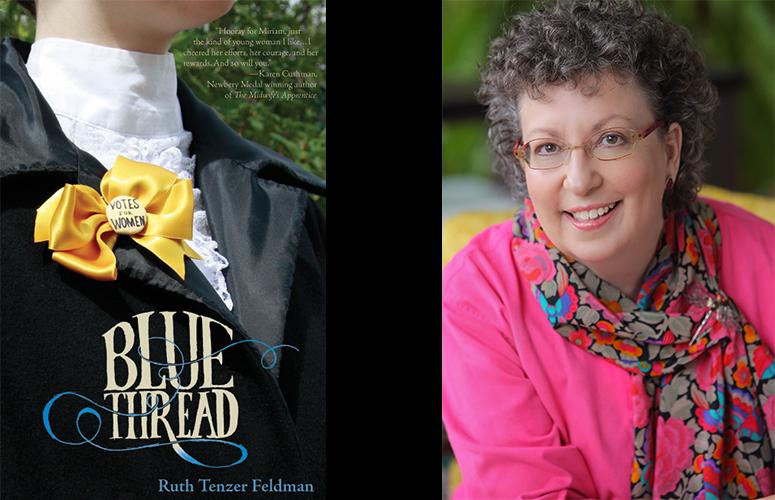 Without giving away too much, “Blue Thread” tells the story of Miriam, a young Jewish girl in the early 1900s whose attempts at transcending the expectations of her gender are frustratingly rebuffed. Through the magic of a blue thread on a very special prayer shawl — belonging, it seems, to her great-grandmother — Miriam is thrown into the distant past, where she encounters the Daughters of Zelophehad and takes part, first hand, in a fight for the rights of these strong women. As Kirkus Reviews points out on the book’s back cover, it feels a bit like “Devil’s Arithmetic”: that is, there’s a time travelling heroine re-visiting Jewish history.
Unlike that book, however, which connected contemporary Jewish identity with the legacy of the Holocaust — an unsurprising approach given when that book was first published — Feldman’s story has much more to do with disparate parts of the Jewish world trying to understand themselves: values and ethics, the voices of women and men, and the tension between progress and tradition. While some may already know the biblical story of the Daughters (check out the Book of Numbers, those who don’t), this is an effective introduction geared specifically toward young adults.
That its primary audience might be young readers should, however, be no obstacle to curious others. Feldman’s prose is simple, yes, but not sterile or dull. Each of her primary characters has something of a unique voice and manner of speaking; dialogue flows well between characters. This is no small achievement in any genre, but its absence is often given more of a pass in YA lit because of its less discerning audience. The book’s first-person narration is an effective choice too, given Feldman seeks to provide a platform for these strong female characters to express themselves. Miriam is a sympathetic heroine, and her observations about the world she’s from, and the one in which she finds herself, are insightful and compelling. With economic language, Feldman paints a vibrant picture. She never over-explains, nor does she commit that chiefest of all sins: telling the audience, rather than showing them.
Feldman exudes a playful respect, as if willing to acknowledge the inherently silly nature of a time travel plot, but urging the reader to join her for the ride. To do so is entirely worth it. As I was explaining to my fiancee while putting together this review: if I had a child, I’d want that child to read this book. It’s a cheesy sentiment, perhaps, and I haven’t failed to notice the rising levels of strong, positive female leads in many other places. But “Blue Thread’s” unique Jewish angle, coupled with the popular tropes of YA novels, makes it especially poignant.
This is a book every synagogue library would do well to carry. With “Blue Thread,” Feldman has made a not-insignificant contribution to recent Jewish fiction: strongly ethical but never preachy, thrilling but never garish, inspiring but never chintzy. That it’s geared to touch an impressionable audience always in need of positive vibes to outmatch a seemingly endless barrage of media negativity, body-shaming, victim-blaming, and casual prejudice, makes it all the more necessary.
For more information about Feldman in general or “Blue Thread” in particular, check out this interview by New Voices’ own Simi Lichtman.